Chief Executive Officer
Where did we lose the most money last month, and do we know why?
$740K
unexplained, of $1.2M lost last month
62% of the unexplained loss: SAG mill below rate, night shift.
AI superintendent for mining operations
Winze finds the hours your equipment runs without producing, prices them in dollars, and traces each one to its cause. It answers everyone on site, from the CEO to the mine superintendent, in plain language, so losses are fixed in the shift they happen, not discovered at month end.
“Why was the primary crusher idle on night shift?”
Starved of feed. Motor drew power, belt scale read zero: 3 gaps, 01:00–04:30. No crusher trip or fault; feed from the ROM pad stopped.
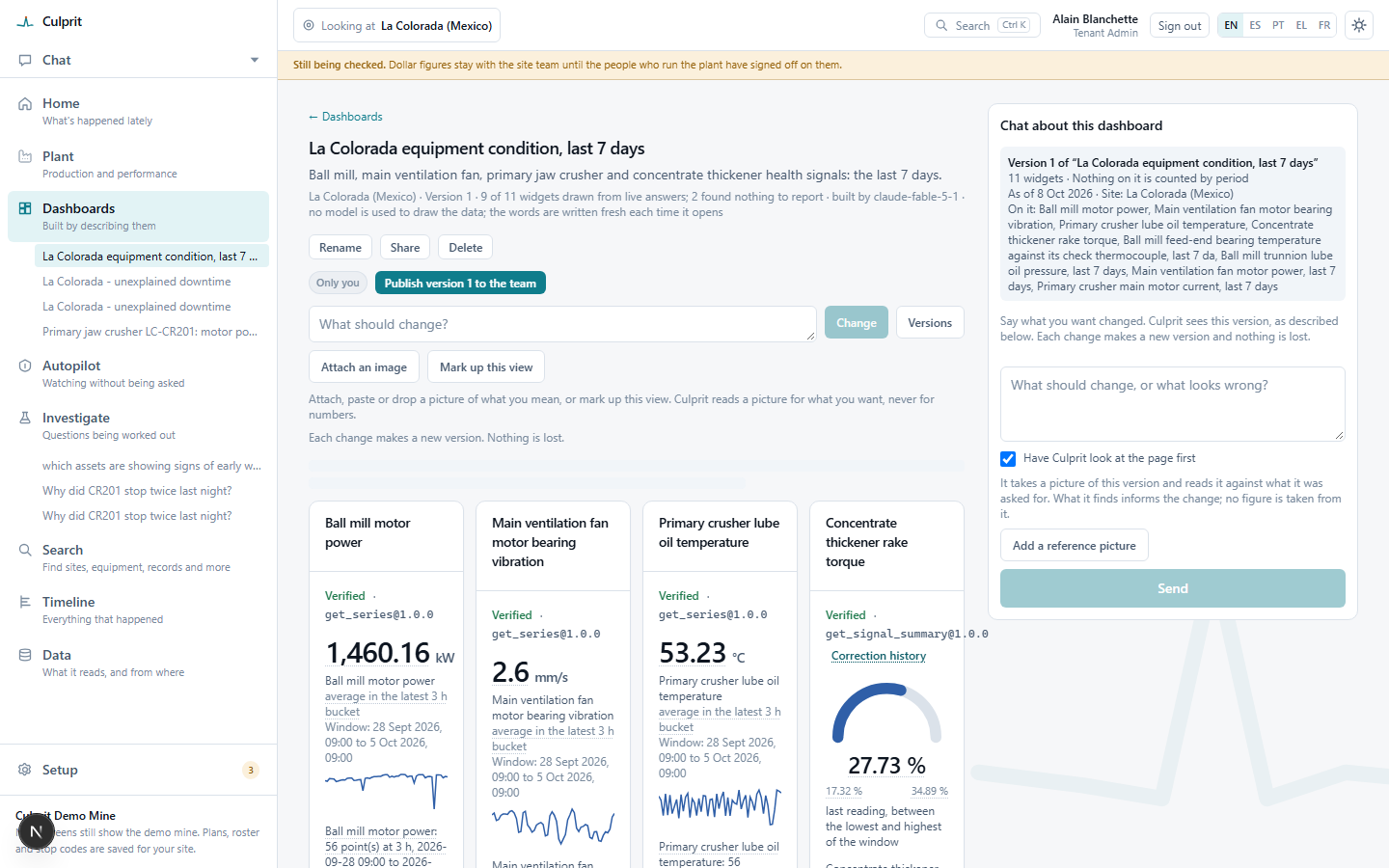
What it checked
Illustrative conversation. Figures are examples, not customer data.
The problem
–50%1
Mining productivity, 1997–2023: it fell by half while other sectors grew
41–44%2
average effectiveness of open-pit shovel and truck fleets, against 85% world class
<1%3
of the data miners collect from their equipment is used to generate insight
Sources
The gap is operational
Outside the mine’s control
Harder geology
Lower grades, deeper pits and longer hauls1
Inside the mine’s control
Why we built Winze
25%5
below mid-2000s productivity, even with geology stripped out
That gap is operational, so it can be fixed. Winze finds the hours equipment runs without producing, prices them and traces each one to its cause within the shift.
Sources
Ready is not working
Ready vs working · open-pit haul fleet
97%
available
36%1
actually used
Trucks were ready; the operation left them idle.
Reported vs measured · opencast colliery
83%
reported by the site
71%2
measured on the ground
Site reports overstated utilisation by 12 points.
Shift change
Up to 30 minutes of every shift; one coal miner took up to an hour3
Queuing
Mismatched fleets leave trucks waiting while still counted as available4
Underground cycles
Blasting and shift breaks cut effective work to 64% of the day5
Sources
Why losses persist
01
Loss in the shift
A truck queues at the shovel
02
Data is scattered
Across fleet, maintenance and plant systems
03
Built by hand
Engineers spend 2+ hours a day on reports1
04
Seen too late
Month-end close took up to 6 days1
86%2
of mining executives find it harder to hire and keep data science and automation talent
71%2
say the talent shortage is holding back their production targets
47%3
name skills shortages as the biggest barrier to adopting new technology
Sources
What the data can do
Published results at a major copper mine more than 50 years old
+10%1
mill throughput, to 85,000 t a day
+1 pt1
copper recovery, while throughput rose
+5%1
copper production in the months after rollout
–50%1
capital spent versus the planned expansion
The catch
It took a dedicated team of data scientists, which most sites can’t hire.
Winze targets the same kind of result without the team, starting with finding and pricing the hours lost.
| Aspect | A major producer | With Winze |
|---|---|---|
| Team | Team | With WinzeYour existing site team, with no analysts to hire |
| Data groundwork | Data groundwork | With WinzeConnects to the OPC-UA server your site already runs, with no migration project; historians, maintenance and fleet systems next |
| Speed of answers | Speed of answers New mill settings recommended every 12 hours1 | With WinzeLosses flagged as they happen, around the clock |
| Result | Result +10% throughput and +5% copper, on half the planned capital1 | With WinzeLost hours found, priced and traced to a cause within the shift |
Sources
The engine
Visualisations
Charts, dashboards and shift reports, built on request
Industry knowledge
Mining process expertise applied to every analysis
AI and analytics, as one
Analytics computes
statistics, correlation and anomaly detection
LLMs reason
plan the work and explain the result in plain language
The loop · Self-learning
Every investigation is recorded, so earlier runs and incidents feed the next one.
Digital twin and context
Maps what feeds what and ties every signal to its asset
Library of connectivity
OPC-UA today; historians, maintenance and fleet systems next
Without the team
Every answer links to the evidence behind it, so teams can check the numbers before they act.
Ends overstated reports
AI does the integration work, so no one builds it by hand: OPC-UA today; historians, maintenance and fleet systems next.
No data build needed
Gets sharper with every question your team asks and every answer they confirm.
No analysts to hire
AI watches your data around the clock, checks its quality and flags losses as they happen.
No month-end surprises
How it works
every signal, every shift
Connected to the OPC-UA server already on site, it reads continuously, in small budgeted steps, without anyone asking.
hours that ran without producing
Equipment drawing power with nothing moving through it: the loss a month-end report shows without a cause.
each hour in dollars
Hours running without producing, times the value of lost output, split into explained and unexplained.
plain language, evidence attached
Each finding traced to its cause in words a superintendent uses, every figure opening to its readings.
Everyone on site
Illustrative conversation. Figures are examples, not customer data.
Chief Executive Officer
Where did we lose the most money last month, and do we know why?
$740K
unexplained, of $1.2M lost last month
62% of the unexplained loss: SAG mill below rate, night shift.
Site General Manager
Draft my summary for Monday’s ops meeting.
$286K
unexplained last week, top three ranked
Mine Superintendent
Why was the primary crusher idle on night shift?
2.4 h
running without producing · $41K lost throughput
Starved of feed. Motor drew power, belt scale read zero: 3 gaps, 01:00–04:30. No crusher trip or fault; feed from the ROM pad stopped.
See it on your own plant. Book a pilot and we’ll run it with you on one site: the unexplained loss on your plant, priced, with its evidence.
Connect one site
OPC-UA, read-only, one command on site
Run it for 90 days
Chat, shift reports and Scheduler tasks
Review the findings together
The unexplained loss, priced, with its evidence